
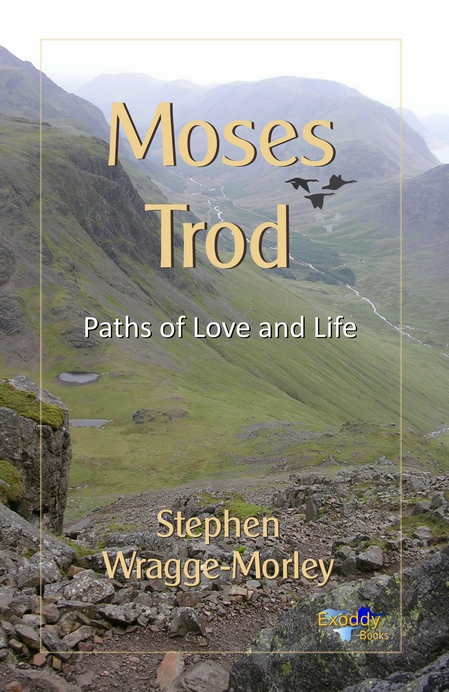
I wrote Moses Trod over a two year period working evenings and weekends. It was something of a relief from my increasingly frustrating day job at that time, but it turned into something rather more as the story progressed. I started with a rough plan, but experience has shown me that having too much detail at the start is not a good way to write a novel any more than it is to write songs or music. The best bits of most creative endeavours are the surprises that turn up out of the blue, as it were: the inspiration. In the case of music, that can often be a happy accident or mistake. In the case of Moses Trod it was an unexpected and unusual event that caused me to twist the story in a different direction. I woke up early one morning to find a tramp sleeping in a wedge of cardboard on the bench that lived on our front porch. A good as spot as any, I guess. I had seen this man about the town and countryside for some time. He was a large man and a harmless fellow, I think, but he was also the inspiration for Moses the tramp, for which I thank him.
I wanted to include the popular/rock music industry into the story and that is where I started, but I also wanted to venture beyond that into big business in general and find correlations or juxtapositions between the well-heeled world of property and finance and the quite different and perhaps more valid lives of ordinary folk. In short, the story is a bit of a mix and operates on many levels. Hopefully, this creates a deeper view of the world we live in than just a single narrative can achieve. Only you, the reader, can judge if I succeeded in that.
I did come up against one problem that I should have anticipated. The title, Moses Trod, clearly meant religion in the eyes of some potential readers (who perhaps did not read the blurb…). Religion is not a feature of the book. When I came to review Moses Trod last year (2025) I thought about changing the title to overcome this prejudice, but decided not. To my mind, it is exactly the right title for the book!
I think that the following quotation from the book shows something of the purpose lying behind the story: “… Our modern life of fashion has lost some of the art of communication. It is partly the medium, television too often leads to a passive disparate audience, listening but not participating. Our society is too safe and too comfortable. Even if you go to a gig, it’s them up there on stage and us down below. We have lost the ability to see the power of mystery all about us even though, clearly, we do not understand life. We claim civilisation but I see little around me that is civilised. We laud wealth. We hoard wealth. We claim ownership of land that can never be ours. We claim ownership of people through a culture that subdues or enrages with fashion or religion or politics or taboo, but it just prostitutes the individual in the name of society. The industrial world enslaves as surely as the Romans did or feudal barons or plantation owners did. I want to try to find a new simplicity that can somehow touch society for just a short while but does not seek to harm it. Music is the only thing I have found that can do that with its universal language. It is the machine code to the human imagination, there is no need for interpretation, it speaks direct. So you see, when I heard the girl sing, I understood the fundamentals of music, the naïvety and purity of emotion distilled into a voice. It meant something to me and everyone there that night. We don’t have long, you see. Each of us is alone on this earth inside our own heads trying to make sense of it all, but one short lifetime is hardly sufficient.”
Moses Trod is all about the paths of love and life.
Paperback edition: 553 pages. Approx: 240,000 words. ISBN: 978-0-9570621-9-1
Available to buy online from: Great British Bookshop
 Exoddy